For teachers of Russian as a Foreign Language (RFL) and students
A platform for learning Russian vocabulary and spelling based on a frequency dictionary
A database of the 5,000 most frequent Russian words is ready to use. Choose a level or topic — Spell App will organize learning, spelling games, spaced repetition, and testing for the student. You will receive detailed reports and recommendations.
Why spelling matters
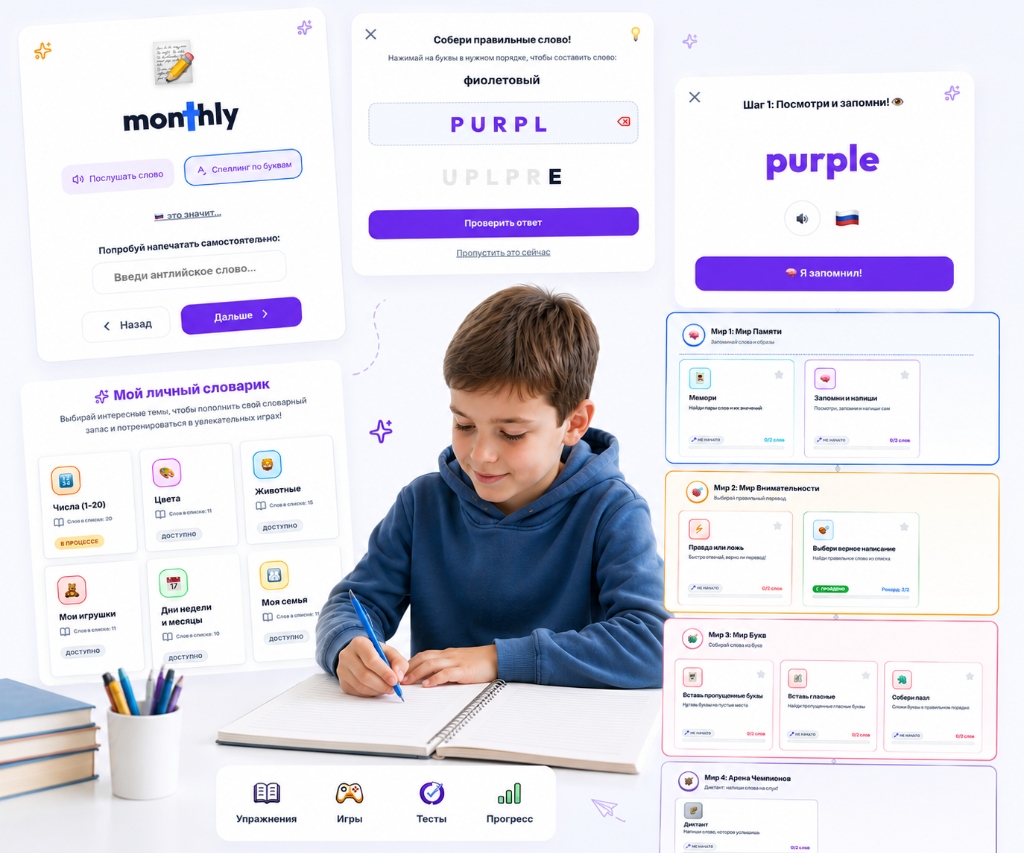
Spelling Russian words correctly builds literacy and confidence in communication.
Knowing Russian words and writing them without errors do not happen on their own just through reading and speaking. Regular, structured practice is essential.
When learning Russian, it is recommended to:
Spend about 20 minutes a day on spelling practice.
Start systematic work from the very beginning of vocabulary acquisition.
Organize spaced repetition for long-term retention.
Develop phonemic awareness and sound-to-letter matching (especially for difficult vowels and consonants).
The Teacher's Challenge
When learning a new language, the volume of vocabulary grows faster than the student can master its spelling.
When there are many words, it is difficult to manually manage word lists, students of different levels, audio materials, games, repetition, and clear reports.
Vocabulary Analysis: Levels A1 — C1
We analyzed the frequency dictionary structure and categorized words by difficulty levels.
The basic 5,000 words of the Russian language cover over 90% of any Russian text. Learning is divided into sequential language levels.
most essential words (elementary level)
words for basic communication
words for everyday life and studies
words for fluent communication
First 2,000 Words
Cover up to 85% of spoken and written language
Mastering the first 2,000 most frequent words allows understanding the main content of texts and participating in most conversations. However, it is crucial to practice their spelling to automaticity.
Level B1 — a critical milestone
Requires learning about 3,000 words. At this stage, the student transitions from basic topics to expressing complex thoughts and reading the news.
Orthographic traps
Russian spelling has many unstressed vowels, silent consonants, and alternating roots that require regular training.
Spaced repetition
Without repetition, a student forgets up to 70% of learned words within a week. The platform returns words to games right when they need it.
Advanced Level (B2-C1)
Fluency and professional communication
To freely read literature, scientific articles, and write business emails, an active vocabulary of 5,000+ words is required. At this stage, writing complex terms, verbal nouns, and compound words without errors is critical. Spell App helps systematize learning advanced vocabulary.
How Spell App Works
No more need to invent exercises for every word list.
Choose a topic, and Spell App will automatically turn it into a series of games, exercises, and tests with detailed reports.
01
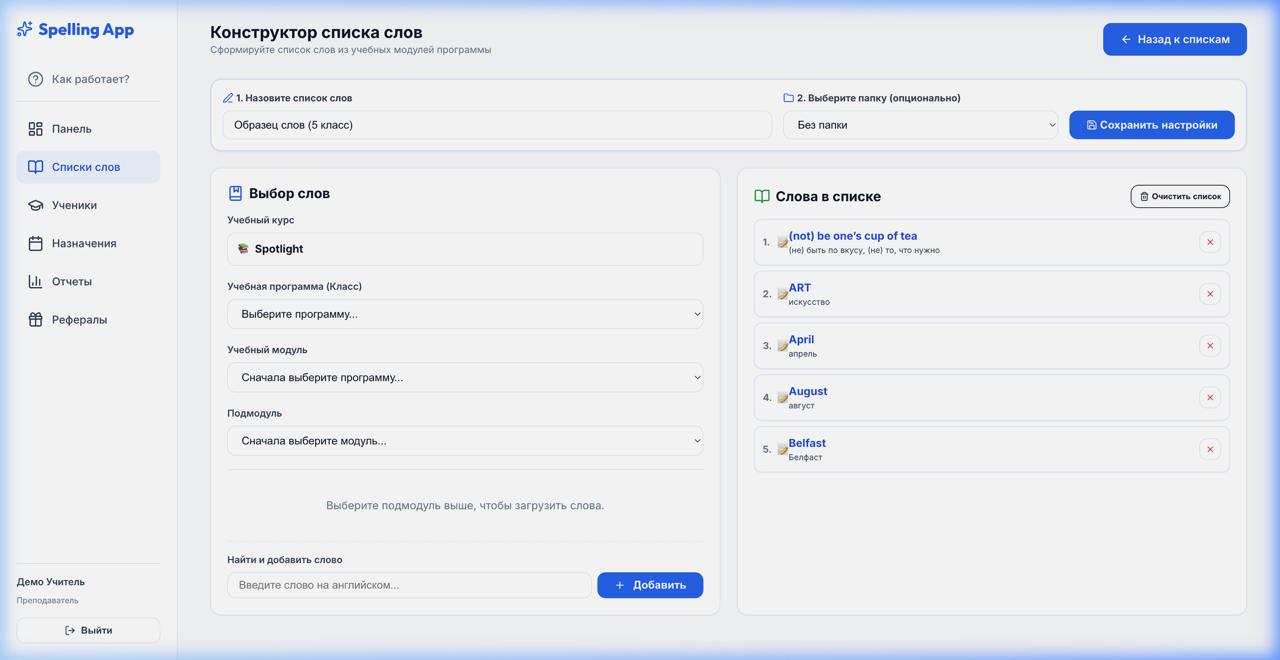
Create word lists
In just a few seconds, you can create a custom list, upload vocabulary, or use pre-made selections from the 5,000-word frequency dictionary.
- by difficulty levels (A1-C1)
- by lexical topics
- by parts of speech
- adapted to students' goals
02
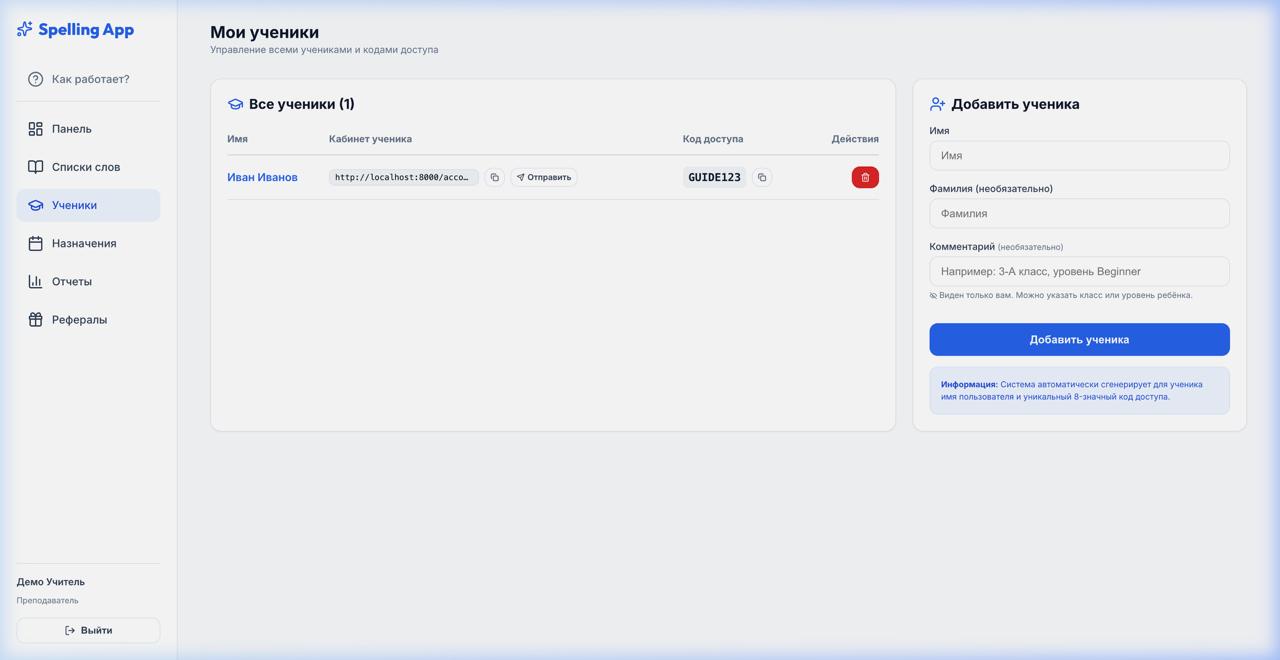
Add students
The teacher creates student accounts and assigns them the necessary word lists: individually, to a group, or for a specific lesson topic.
03
Send the practice link
The student gets a link to Spell App and their access code. They immediately get access to exercises, spelling games, spaced repetition, and tests.
Practice on any device: computer, tablet, or phone.
What the Student Sees
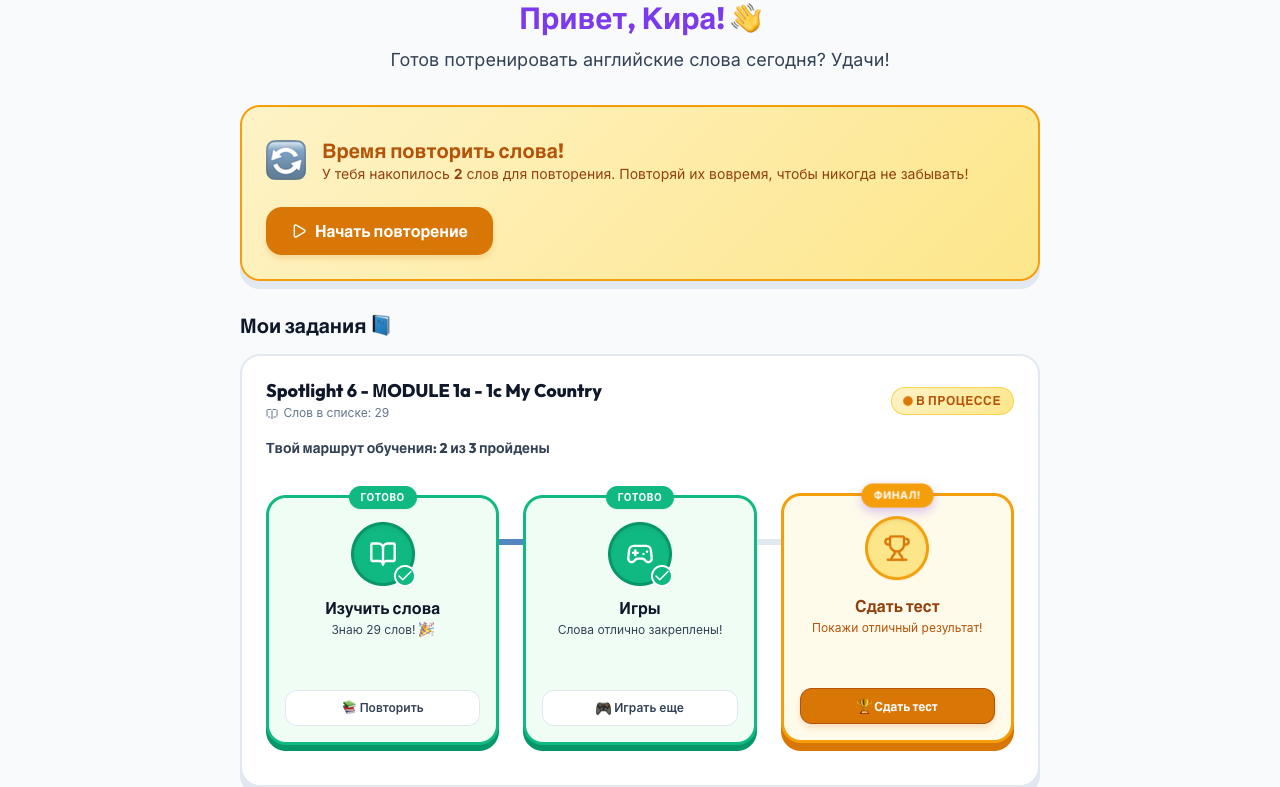
The personal cabinet turns learning spelling into a clear roadmap
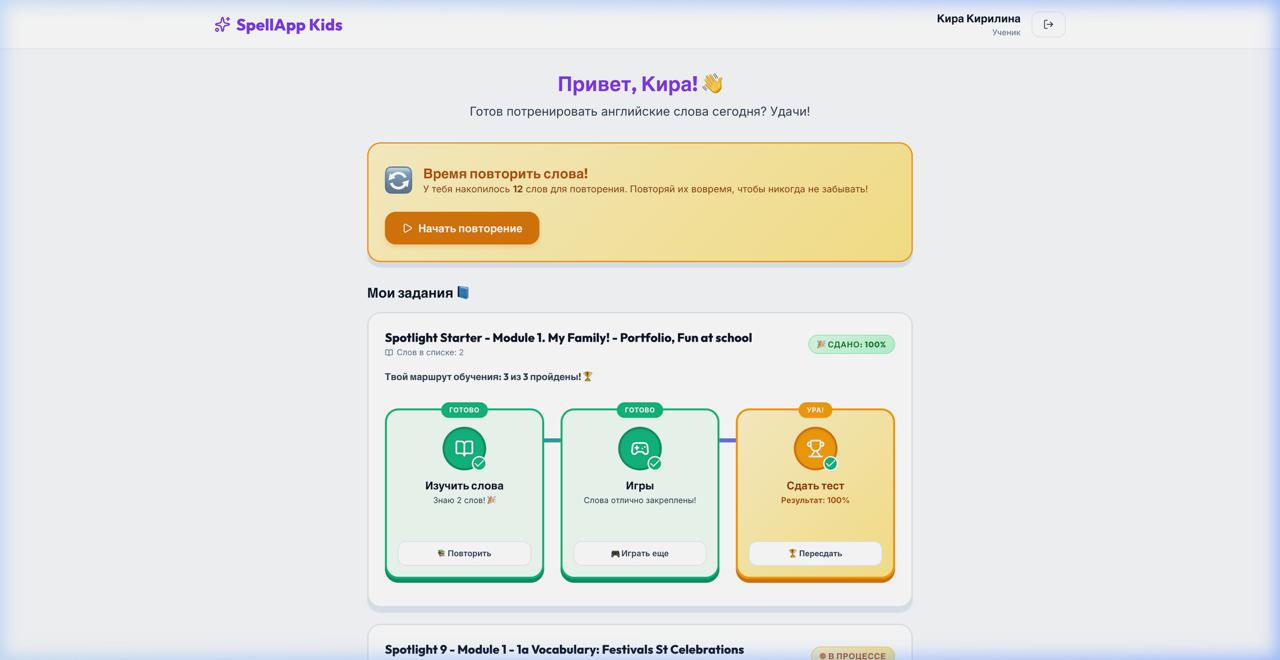
The student does not just memorize words. They see their progress: what is already mastered, what words need to be reviewed right now, what games are available, and when they can take the final test.
Learning Roadmap
Learn words, reinforce in games, pass the test
Each lexical topic is divided into three clear steps. The student knows exactly where they are and what action to take next.
Repetition based on the forgetting curve
The roadmap is visible on a single screen
Final test as confirmation of mastery
01
First, the student gets to know the word
They see the spelling, translation, can listen to the correct pronunciation, and try typing the word on their own.

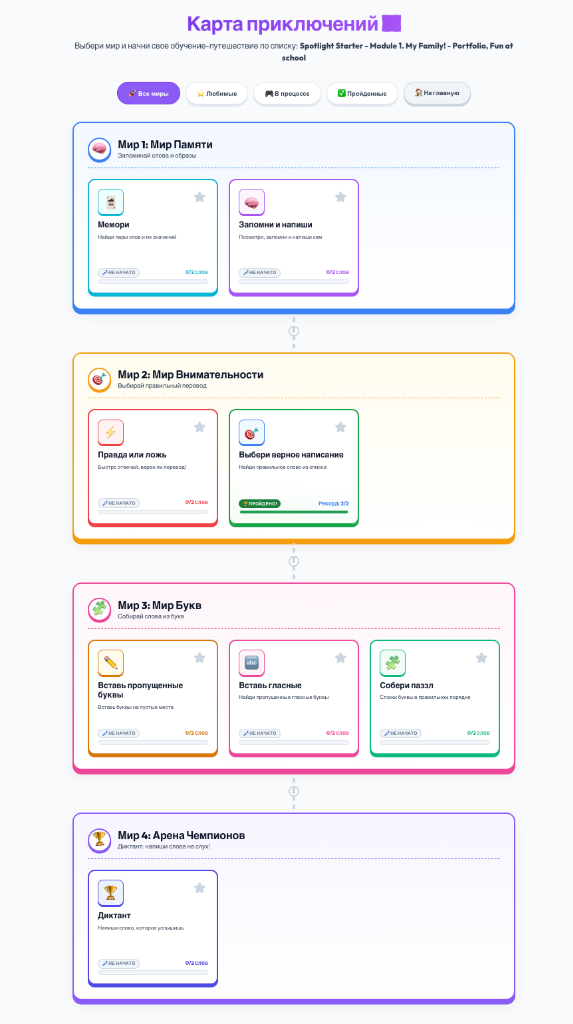
02
Then, they reinforce vocabulary through games
The cabinet offers engaging mechanics: memory game, dictation, multiple choice, missing letters, and other exercises.
03
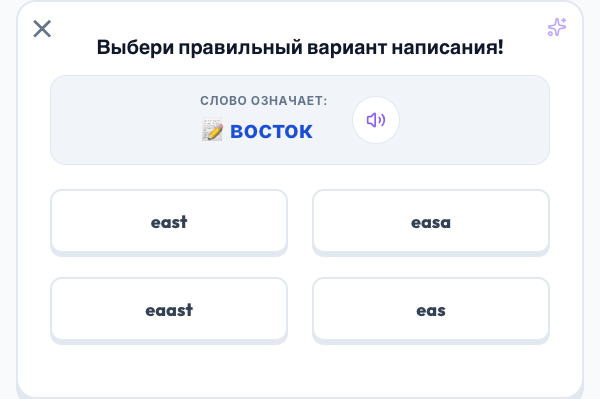
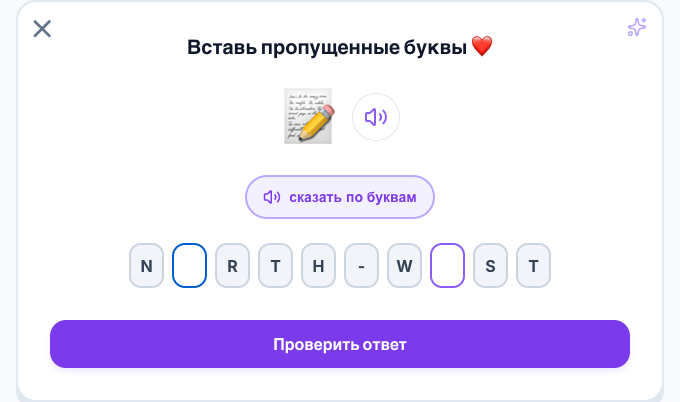
Spelling is practiced selectively
Game mechanics focus on tricky parts: the student selects the correct form of the word, inserts missing letters, and memorizes spelling patterns.
Track Progress
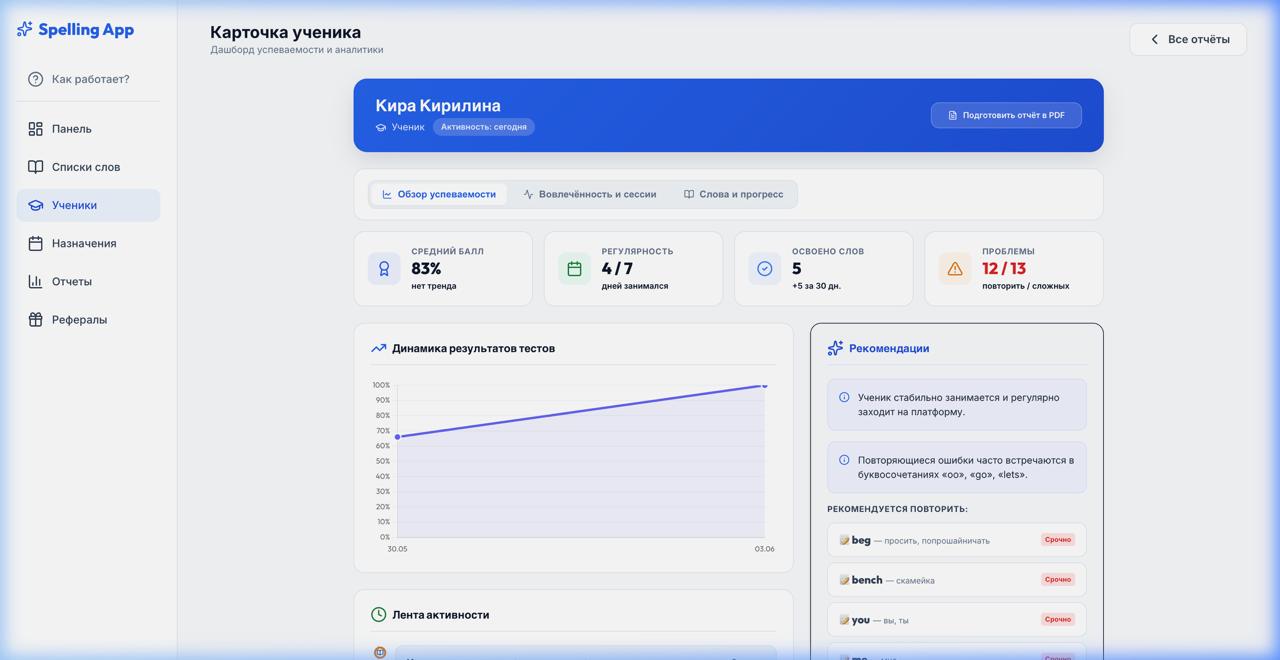
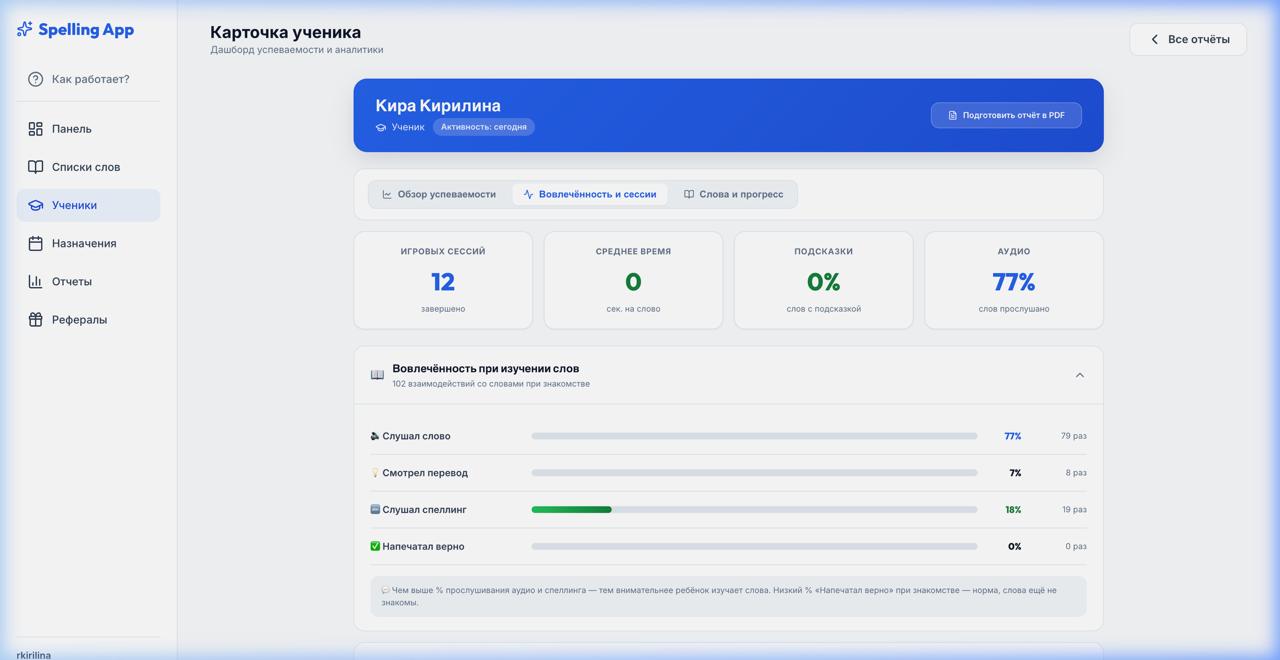
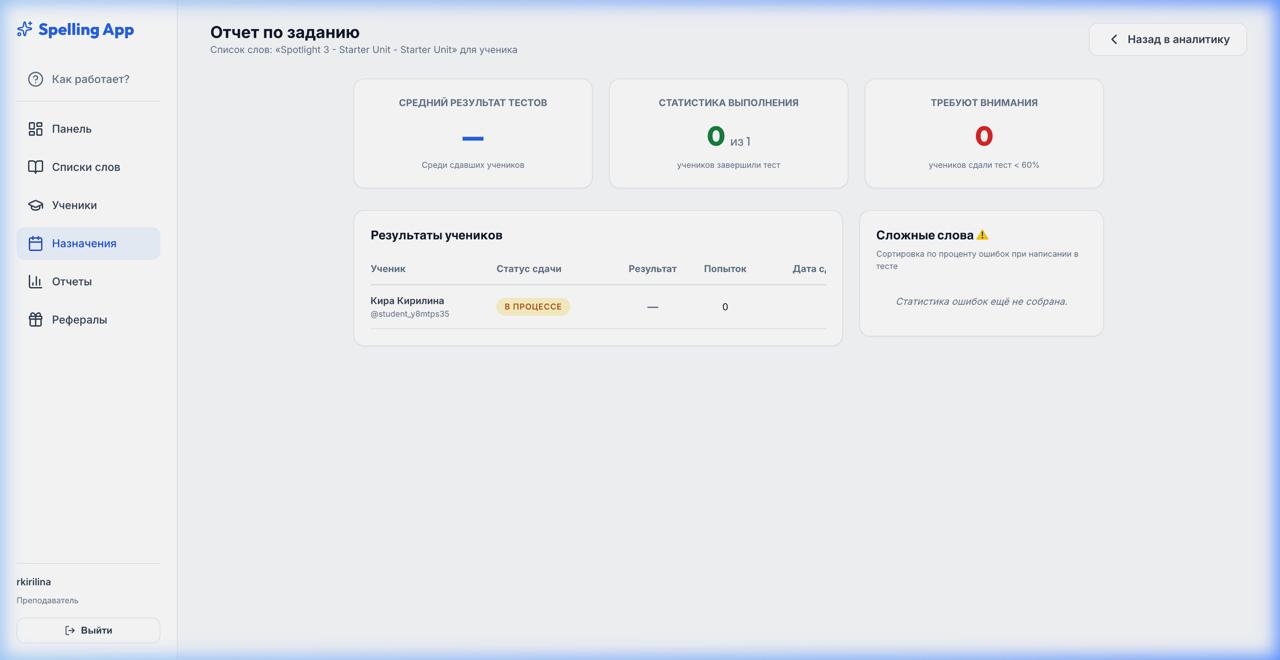
The system automatically collects data for each student
The teacher sees detailed results, tricky words, and common spelling mistakes. These reports help flexibly adjust the learning program.
Summary
Russian is a challenging language to master.
Due to complex spelling rules and a large volume of vocabulary, students struggle to write correctly and confidently.
Spell App makes vocabulary work systematic, regular, and fun.
Less forgetting. Less routine for teachers.
More literacy and confidence in Russian.
turns word lists into exercises, interactive games, and tests
automatically organizes word reviews until they are firmly memorized
timely returns words that the student starts to forget to exercises
helps write without typical spelling mistakes
clearly shows progress, test results, and tricky spots in words
saves teachers' time on routine spelling grading
helps reliably save and accumulate active vocabulary over the years